
CDPs: The End

Yes, the title is more assertive than the one I used at the beginning of 2025: CDPs: The Beginning of the End?
Maybe we’ve reached the next episode. Or maybe I just couldn’t resist a clickbait title for once.
Over the past few months, I’ve been asked the same question by vendors, analysts and customers:
Is the Customer Data Platform category still relevant?
It’s a fair question and, conveniently, it grants me permission to write another CDP post.
The CDP category has had a strange few years. It finally received the analyst recognition vendors had been waiting for, just as several of those same vendors started moving away from the label. Some were acquired. Others simply removed “CDP” from their website tagline. Many are now talking about AI, agents, decisioning, content, or experience platforms.
So, is the CDP category coming to an end?
Let’s start somewhere more useful: the product-market fit of the category itself.
Finding the Product-Market Fit for CDPs
I don’t want to rewrite the full history of CDPs here1.
For now, we can use an extremely simplified view: a CDP is the thing sitting between customer data and a UI for business users.
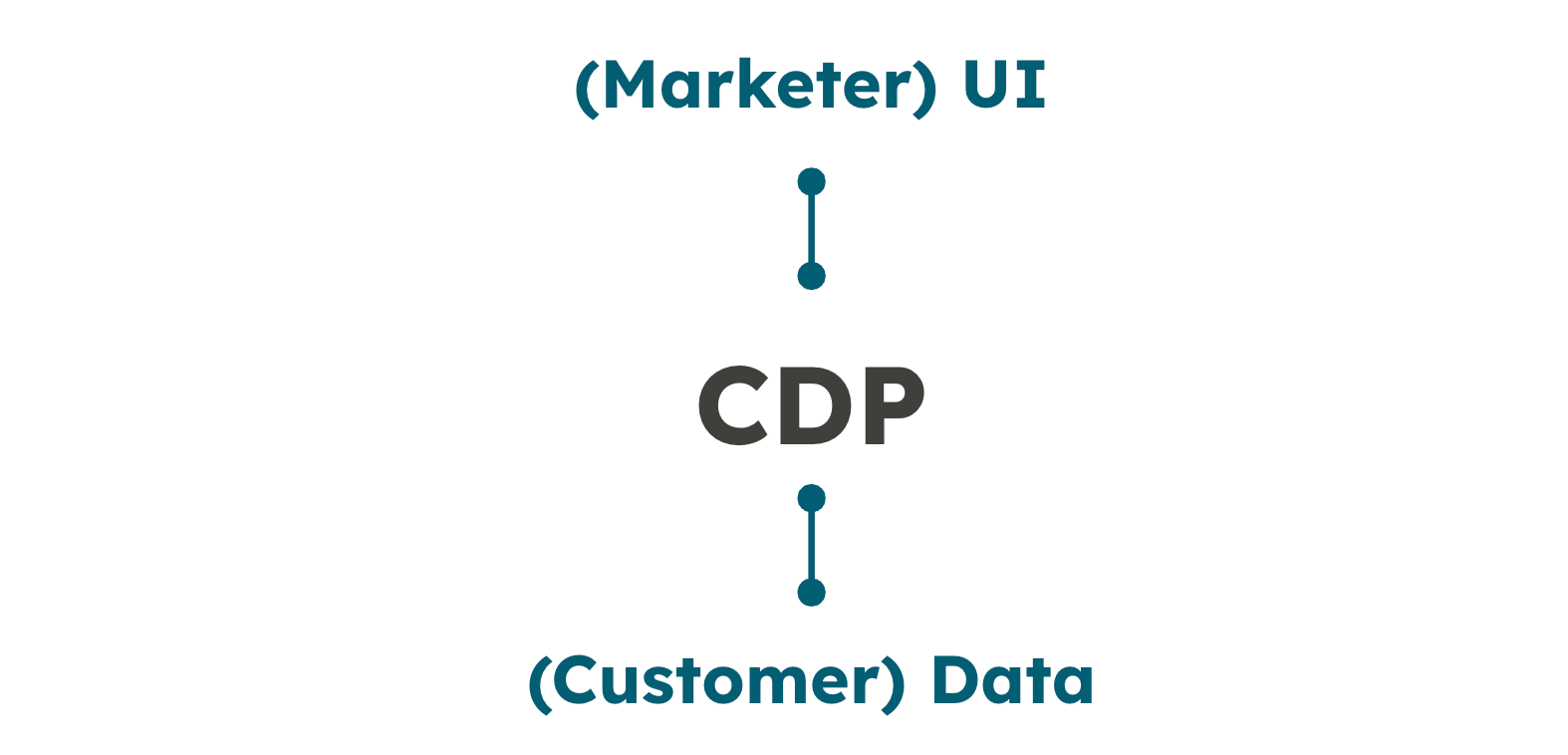
Ok, too simplified.
The data is usually customer data. The UI is usually what allows marketers to access insights, build audiences, and use those audiences for personalization across owned and, sometimes, paid channels.
That gives us two obvious starting points: data and UI.
Data
With the rise of composable CDPs, the data is increasingly expected to stay where it already lives: in the enterprise data platform, whether you call it a data warehouse, data cloud, lakehouse, or something else.
The concept makes sense. For many organizations, it’s now an architectural requirement.
So, if data is no longer the CDP moat, the category has to look somewhere else.
The UI?
UI
Well, it’s going to be hard to obtain a unicorn valuation with a UI.
And that’s not even the biggest challenge.
The UI itself is now being disrupted by AI, more specifically by LLMs. I’ve written at length about how natural language interfaces are changing how users interact with data.
For years, the CDP value proposition was partly about giving marketers a no-code interface to customer data.
But if users increasingly interact with customer data through a chat interface, the traditional martech/CDP interface becomes less defensible as the core value of the category.
So, if CDPs no longer own the data, and the UI is becoming easier to replace or reinvent, what’s left?
Business Semantics
This is where things get more interesting.
Even when customer data remains in a cloud data platform, the actual business use of that data often lives inside the CDP.
Attribute mapping, audience definitions, suppression rules, and journey definitions explaining how the business thinks about customers are stored in a CDP layer.
That layer is easy to underestimate because it doesn’t look as impressive as a clean database or as visible as a UI.
But the industry learned the lesson testing AI with a RAG architecture only connected to the “raw” customer data, not to the business context. Whether the system hallucinates or acknowledges it can’t help the user without access to definitions of “high-value customer”, “active subscriber”, “likely churner”, etc.
In other words, AI needs the translation layer between data and business language.
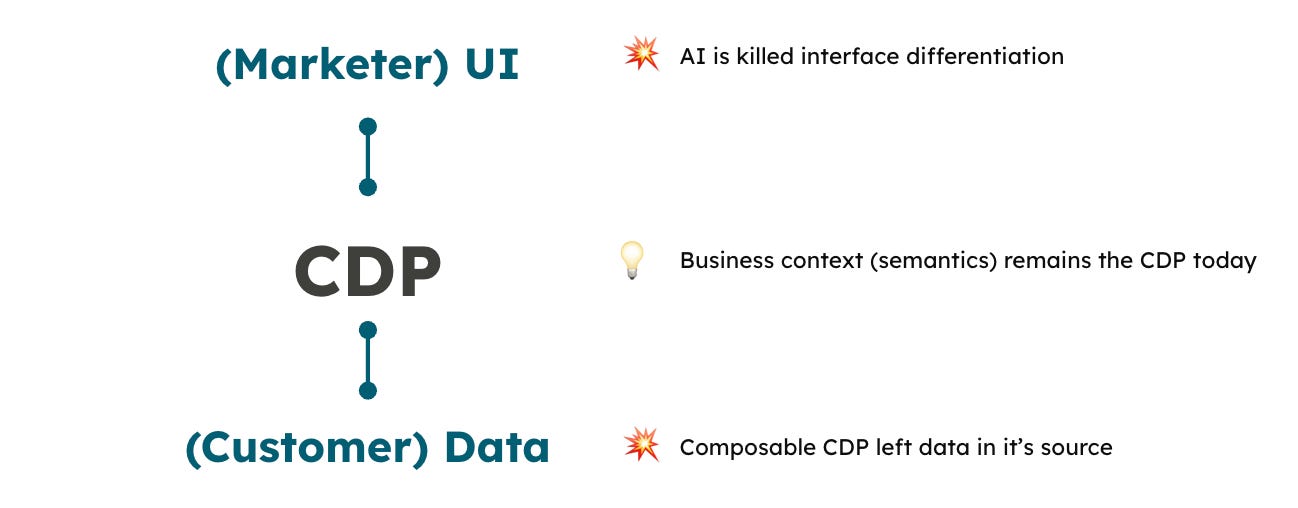
Should that business semantics layer remain inside the CDP? Not necessarily.
Cloud data platforms are already releasing capabilities to define semantic layers closer to the data itself. Define once, use everywhere. The direction makes sense.
But until organizations broadly adopt that approach, and until they migrate years of audience logic, mappings, and campaign definitions out of their CDPs, the business context stored inside those systems remains very valuable.
And CDP vendors understand that. They know this business context may become one of their most valuable assets.
Where Can CDPs Go Next?
If data is moving to the cloud data platform, and the UI is being disrupted by AI, CDP vendors need to find another place to expand.
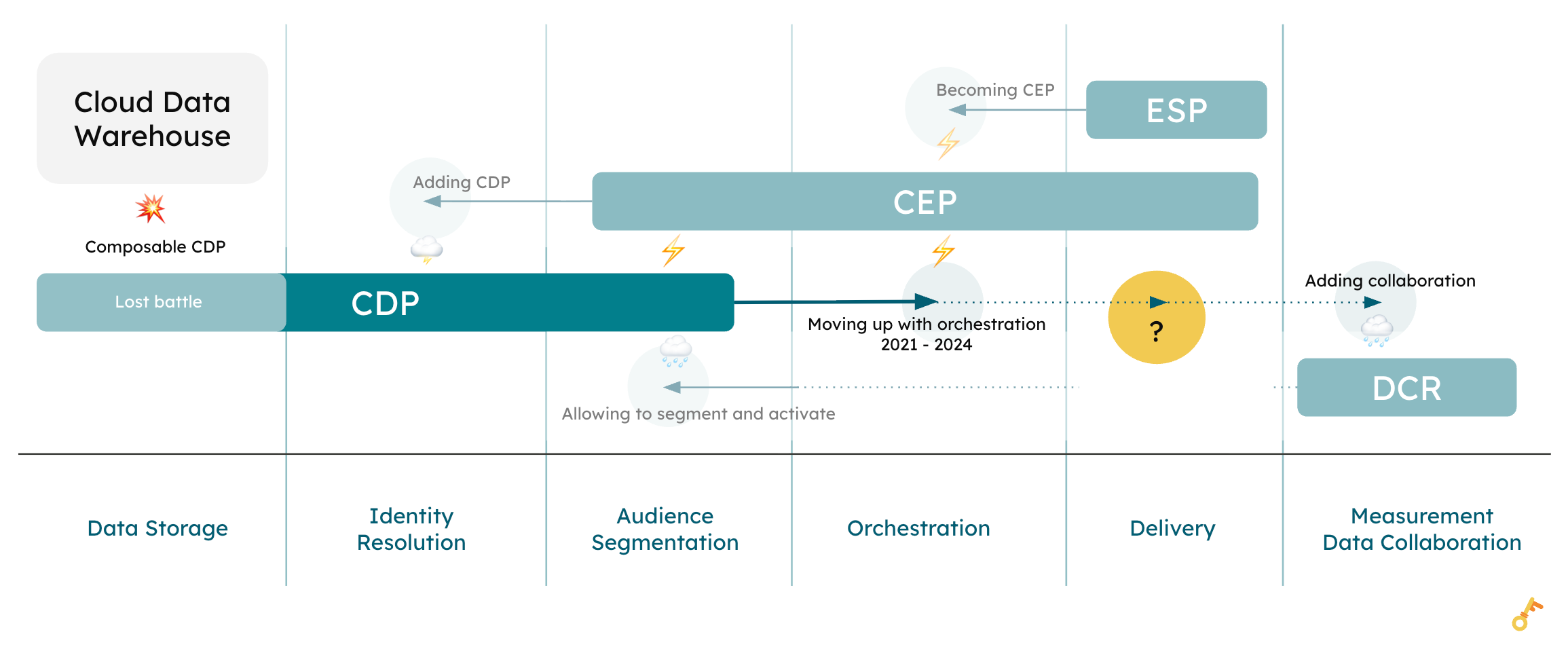
CDPs offer strong audience segmentation layers. From there, the natural next step was to define what happens to those audiences. That’s why so many CDP vendors added campaign or journey orchestration capabilities. Not agent orchestration, let’s keep that confusion for another day, but the good old marketing orchestration layer used to coordinate customer experiences. Most vendors added this in the period 2021–2024.
In other words, the CDP moved right in the stack: Audience segmentation → orchestration.
The next logical step could have been delivery.
Delivery: The Obvious Path
If a CDP defines the audience and orchestrates the journey, why not send the message too?
At first glance, delivery feels like the natural next move. CDPs are dependent on downstream platforms to execute the last mile: email, SMS, push and more.
That dependency is not ideal, it creates friction. But delivery is also not the most exciting place to expand.
Email delivery (via ESP), for example, remains critical, but it is largely a commodity capability. Important? Absolutely. Differentiated enough to redefine the future of CDPs? Less obvious.
There is a reason ESPs are switched so often despite email being one of the most mature channels in the martech stack. The category matters, but the value often sits around it: audience strategy, orchestration, content, etc.
I wrote about this in 2023 when looking at how to find the right ESP. The delivery engine matters, but it is only one part of the equation.
So yes, CDPs could have moved into delivery, but today they haven’t made this a priority.
Decisioning: The Stronger Battleground
A more compelling path is decisioning.
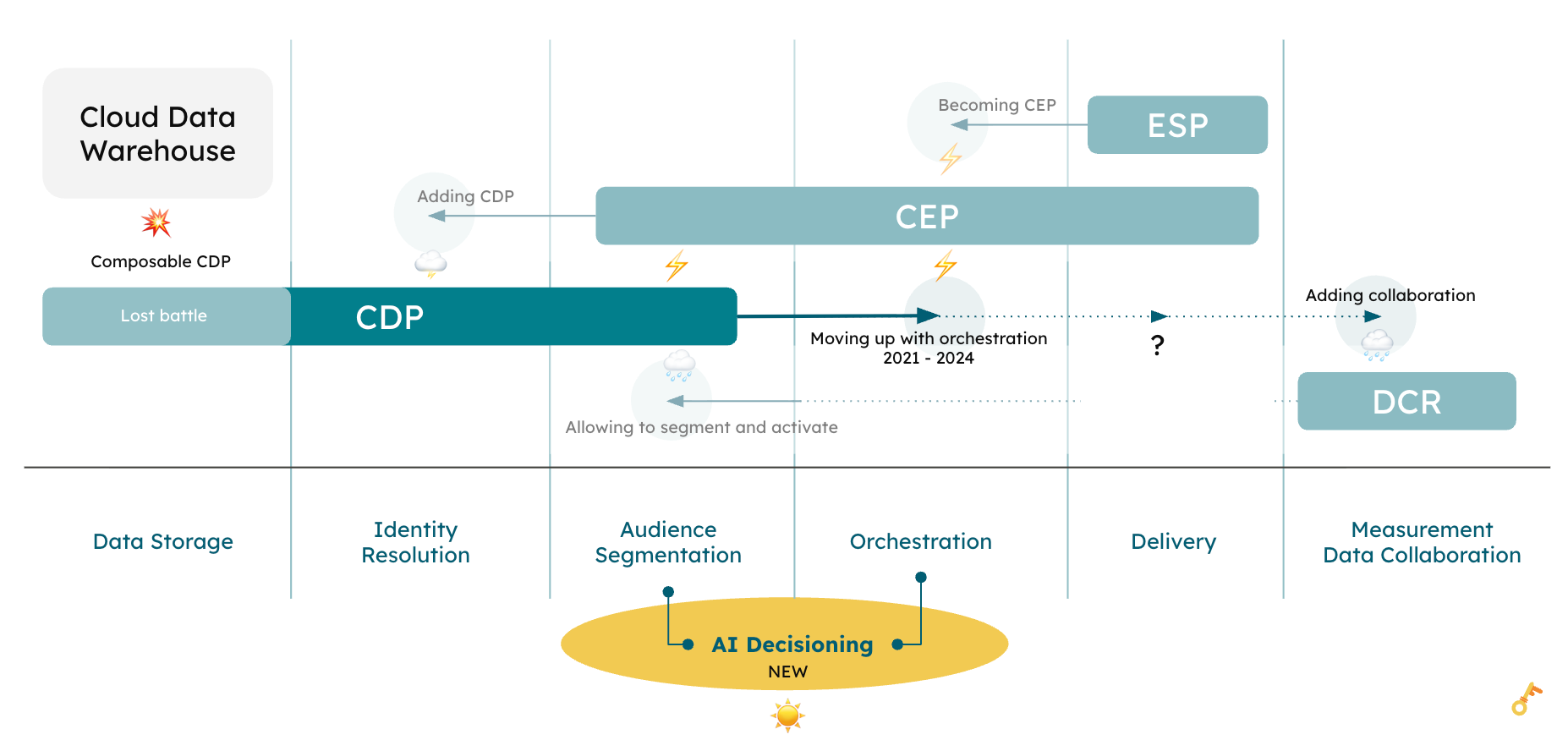
I know, it’s broad, and could encompass many decisions: Who should be targeted? What should they receive? When should they receive it? On which channel? With which offer?
And now, as AI enters the stack, the question can go even further: which agent, skill, model, or tool should be used to complete the task?
Decisioning feels like a bigger problem to solve for marketers. Marketers don’t struggle because they can’t send another email. They struggle because every customer journey creates too many decisions for humans to define, test, and maintain manually.
Rule-based systems gave marketers control. But the more rules you add, the harder they become to manage. Eligibility rules, exclusions, priorities, timing logic, channel preferences, offer constraints... it gets messy fast. I’ve seen it first-hand deploying these systems for customers.
AI-powered decisioning is looking to address that. We’ve seen vendors such as Hightouch (AI Decisioning) and Braze (acquisition OfferFit acquisition) make some moves where other Martech vendors got quiet capabilities in a space (Offer Decisioning with Adobe) often associated with larger legacy vendors: Pega and SAS.
Then, there is a less obvious, but increasingly interesting, path for CDPs.
Content: The New Wildcard
Content was never really in the purview of CDPs.
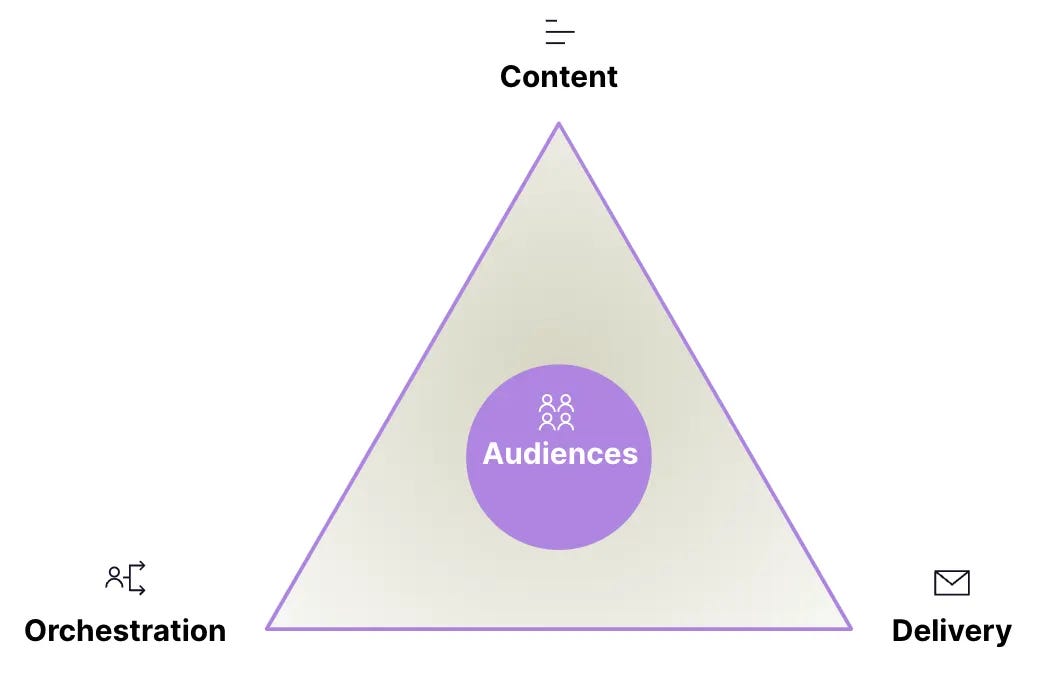
CDPs were about customer data, identity, audiences, activation, and later orchestration. Content lived in other systems such as DAMs, CMSs or delivery tools such as ESPs and CEP.
ESPs and CEPs never developed advanced content creation tools. Templates are often created in external solutions by creative teams, while marketers can make small tweaks in the delivery environment, such as moving a block or changing an image.
CDPs moved from audiences to orchestration, and I assumed the next expansion would be Delivery. We didn’t see that happen.
In parallel, AI is changing the content conversation. Copy generation has been the earliest and most adopted use case for LLMs. Insert a text box in your product UI, connect it to an LLM, and here you go, users can now generate marketing copy for email, SMS, ads.
What makes it more interesting of course is when that copy generation is grounded in the business context already stored in the CDP.
That may start small: subject lines, message variants, offer text, channel-specific copy.
Then it could expand into content assembly: selecting approved blocks, matching images to audiences, adapting creative to channels, and personalizing messages based on customer context.
I don’t expect CDPs to become full DAM or CMS solutions. At the same time, nothing prevents them from offering some simple content creation or update in a modern approach from what was already offered through ESPs, CEPs and similar solutions.
Another good news for CDPs: today most content and content data is absent from cloud data platforms. Et voilà! This could be a path for CDPs, looking into a massive market, disrupted, and currently untouched by cloud data platforms.
For Adobe, the move is obvious. They started with a creative business before building a marketing technology ecosystem. Hightouch likes to touch everything and announced Content Assembly in February. Treasure Data, now Treasure AI, promotes a Creative AI Suite on its website.
The shift is en route!
CDPs: The End?
Back to the original question: is the CDP category coming to an end?
When everybody is asking the question, and vendors are moving the CDP label to a corner of their website (or into the footnotes) you certainly don’t need me to answer that.
So what’s next? The birth of a new category?
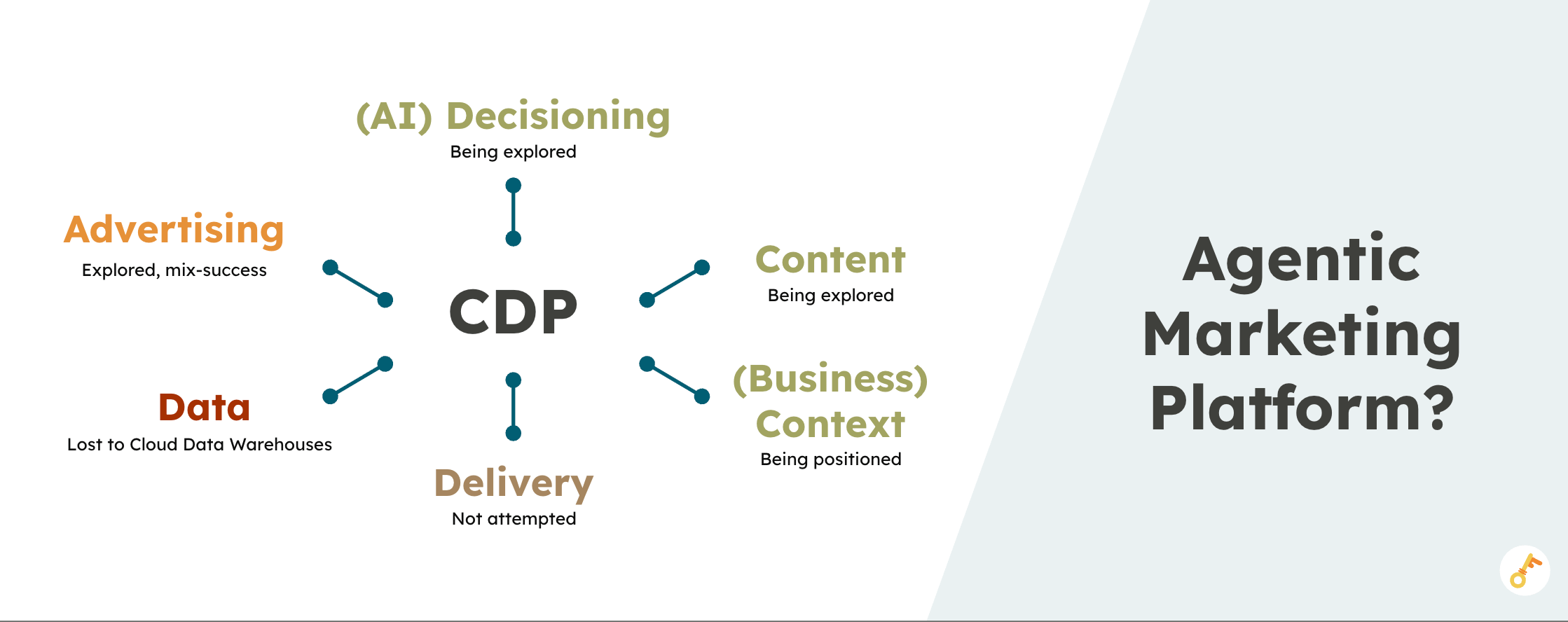
It’s likely that something new, with a three-letter acronym, will emerge. Hightouch is pushing Agentic Marketing Platform, while Treasure AI is betting on Agentic Experience Platform.
I don’t know what will stick, but of course, “agentic” will likely take one of the three spots available 🙂.
🔑 The CDP label may not survive, but another one will arrive.2
Please message me if you want that perspective, and maybe I’ll use it as an excuse for yet another CDP post.
In case you ask, this is actually not an AI-generated takeaway.
Interesting point of view Florian. The observation that AI fails without a translation layer — without knowing what "active subscriber" or "likely churner" means in context — is exactly right.
But there's a prerequisite you don't mention that sits even further left: identity resolution. The semantics layer only holds if the entity underneath it is stable. If "high-value customer" maps to three fragmented records — a loyalty ID, a web session, a CRM contact — the definition is semantically correct but operationally broken. The AI confidently answers the wrong question.
As data moves to the warehouse and CDPs become composable, the identity stitching that used to be a black box inside the CDP needs to become an explicit, open layer. Otherwise the business context that CDPs are now trying to defend is built on a shaky foundation.
Entity resolution is the invisible prerequisite that makes the semantics layer trustworthy — and it's still structurally absent from most architecture diagrams of the composable stack. Wrote my thoughts on this at https://www.learningfromdata.zingg.ai/p/the-semantic-layer-does-not-have