
Decoding General-Purpose LLMs: 3 Reasons for Enterprise Adoption, 3 Reasons Against It

Have you ever used Adobe Photoshop just to crop an image? Don't be ashamed; I have. It was at a time when I was a heavy user and would do way more than just crop an image in most cases. But if you ask anybody today for a tool recommendation to crop images, I doubt Photoshop would come to people's minds first.
When it comes to LLMs, the buzz is currently concentrated around general-purpose LLMs, with a few popular ones being GPT-3.5/GPT-4 (OpenAI), Claude (Anthropic), Command (Cohere), and PaLM (Google).
It's no surprise that enterprises are looking at these options when evaluating LLMs for their GenAI use cases. But should enterprises use these general-purpose LLMs in production?
3 Reasons Against General-Purpose LLMs Adoption
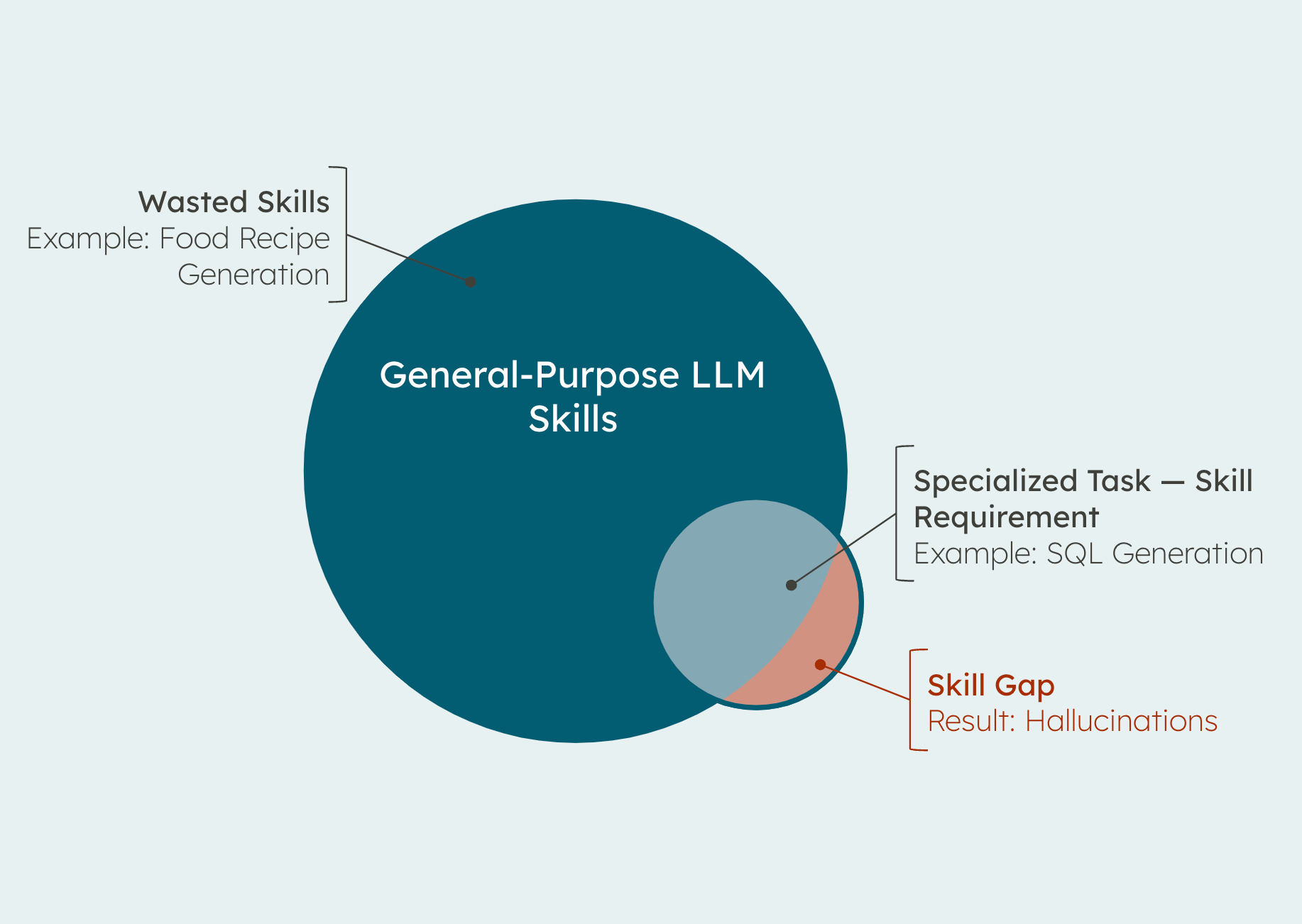
General-purpose LLMs offer the significant advantage of being capable of handling a wide array of tasks and supporting diverse needs and use cases. However, enterprises will face the following limitations:
1. Cost: This limitation takes various shapes and forms. For instance, enhancing LLM performance often involves providing context, a common solution. However, general-purpose LLMs may require more context than specialized LLMs, attempting to compensate for a skill-gap. Utilizing context involves tokens, and tokens come with a cost, thereby driving up GenAI expenses.
2. Speed: The process of identifying the appropriate skill for each task can be a burden for the LLM, slowing down its ability to provide timely answers.
3. Quality: The choice between breadth and depth becomes crucial. General-purpose LLMs are trained to cover a wide range, potentially compromising the quality or depth of answers within each specific domain of application.
3 Compelling Reasons for General-Purpose LLMs
All the above suggests that specialized LLMs will have a significant edge over general-purpose LLMs. However, despite this, there remains a viable opportunity for the adoption of these general-purpose LLMs in enterprises:
1. Cost: As evidenced by OpenAI's recent announcement of GPT-4 turbo, the cost of leveraging these LLMs is decreasing, and this trend will continue. In many scenarios, adopting general-purpose LLMs can end up being more economical than training and utilizing specialized models, especially given the ongoing learning curve in enterprises within this field.
2. Ease of Access: General-purpose LLMs already boast an ecosystem of infrastructure, applications, and users built around them. This ecosystem facilitates their adoption within enterprises.
3. Good Enough Quality: While the performance may not match that of highly specialized LLMs, there exists a realm where the incremental improvement gained from specialized LLMs may not be justifiable. Many use cases and industries won’t demand perfection in LLM performance, making general-purpose LLMs a practical and sufficient choice.
LLMs for Enterprises, general-purpose or specialized?
The answer will be “it depends” and “both” in many enterprises.
If your goal is to crop a series of images to a fixed size, sure Adobe Photoshop can do it. But in most cases, you might prefer a cheaper and lightweight specialized alternative.
In the short term, starting to evaluate GenAI with a general-purpose LLM is certainly going to be the easiest option. However, make sure to revisit this choice along the way.