
Gartner’s CDP MQ 2025: From Gold Rush to Reality Check

Is it just me, or did the release of the Gartner Magic Quadrant for Customer Data Platforms (CDP) feel quieter this year?
Sure, I've seen some commentary online, but it’s noticeably less compared to the buzz in 2024 when the report was first introduced—a significant milestone for CDP vendors and a major validation of the category.
Fast forward 12 months, and the landscape has shifted dramatically. In this post, I'm reflecting on the evolution of the CDP market, using Gartner’s latest MQ as our lens. There are several interesting highlights worth discussing, without disclosing details gated within the full report.
I’d also like to acknowledge the complexity of the analysts' work. Out of respect, I’ll keep my personal views on individual vendor placements to myself.
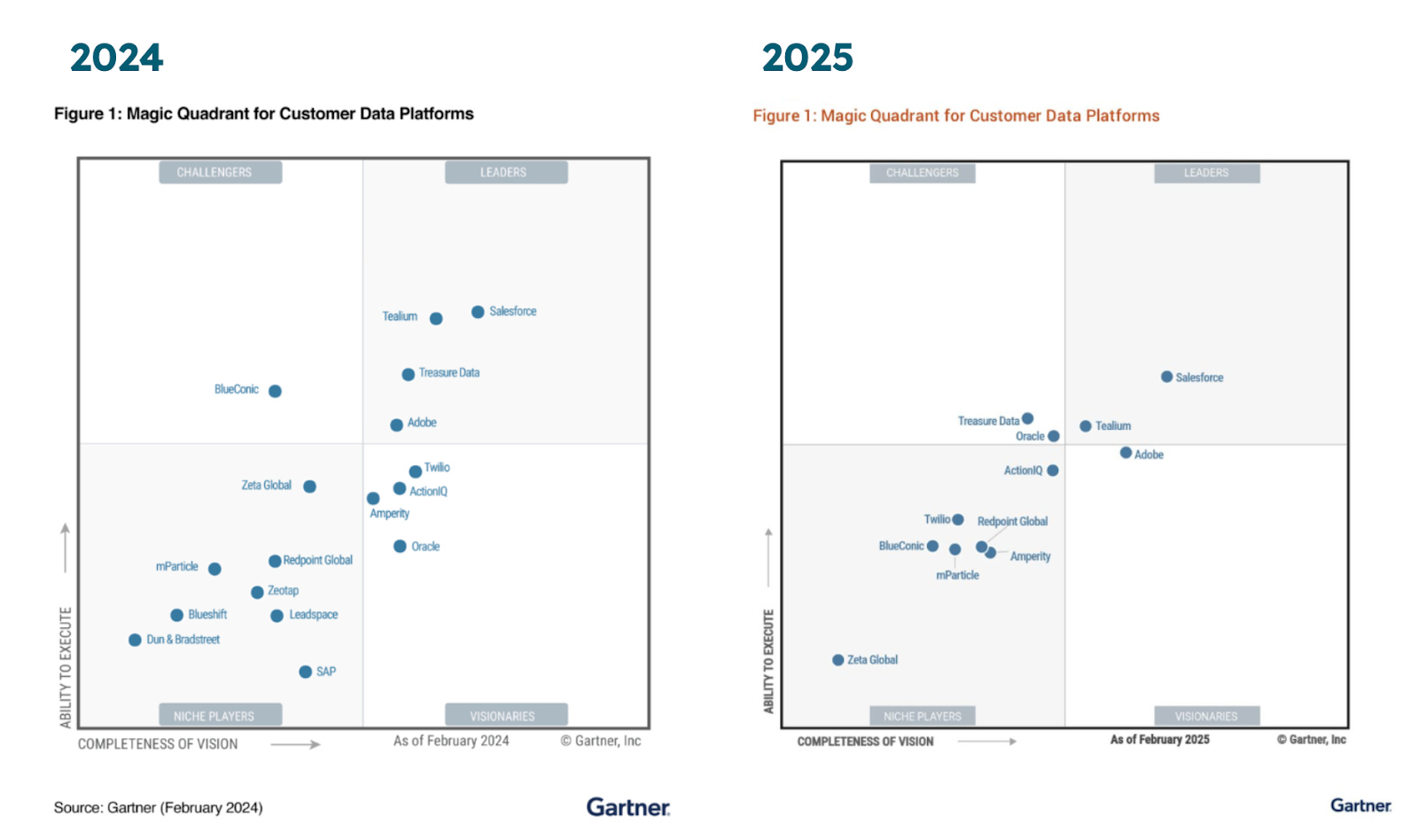
Vendors Out, Nobody’s In
It wasn't too long ago that nearly every vendor claimed to be a CDP—almost like a gold rush. Being among the select few included in Gartner's 2024 report was an achievement, and conversely, missing out seemed like a significant setback.
One of the most notable criticisms circulating online at the time was around the vendor selection itself—specifically, who made the cut and who didn't. The landscape had already begun shifting by the time Gartner published the first MQ, with emerging vendors challenging traditional players and the rapid rise of the composable CDP concept.
This year, I wanted to observe industry reactions before sharing my thoughts. Interestingly, vendor selection once again emerged as a hot topic. David Chan, for instance, recently shared insightful comments on the debate.
Not only no new vendors entered the evaluation, but the bottom five from the previous year—Blueshift, Dun & Bradstreet, Leadscape, SAP, and Zeotap—were dropped from the 2025 edition.
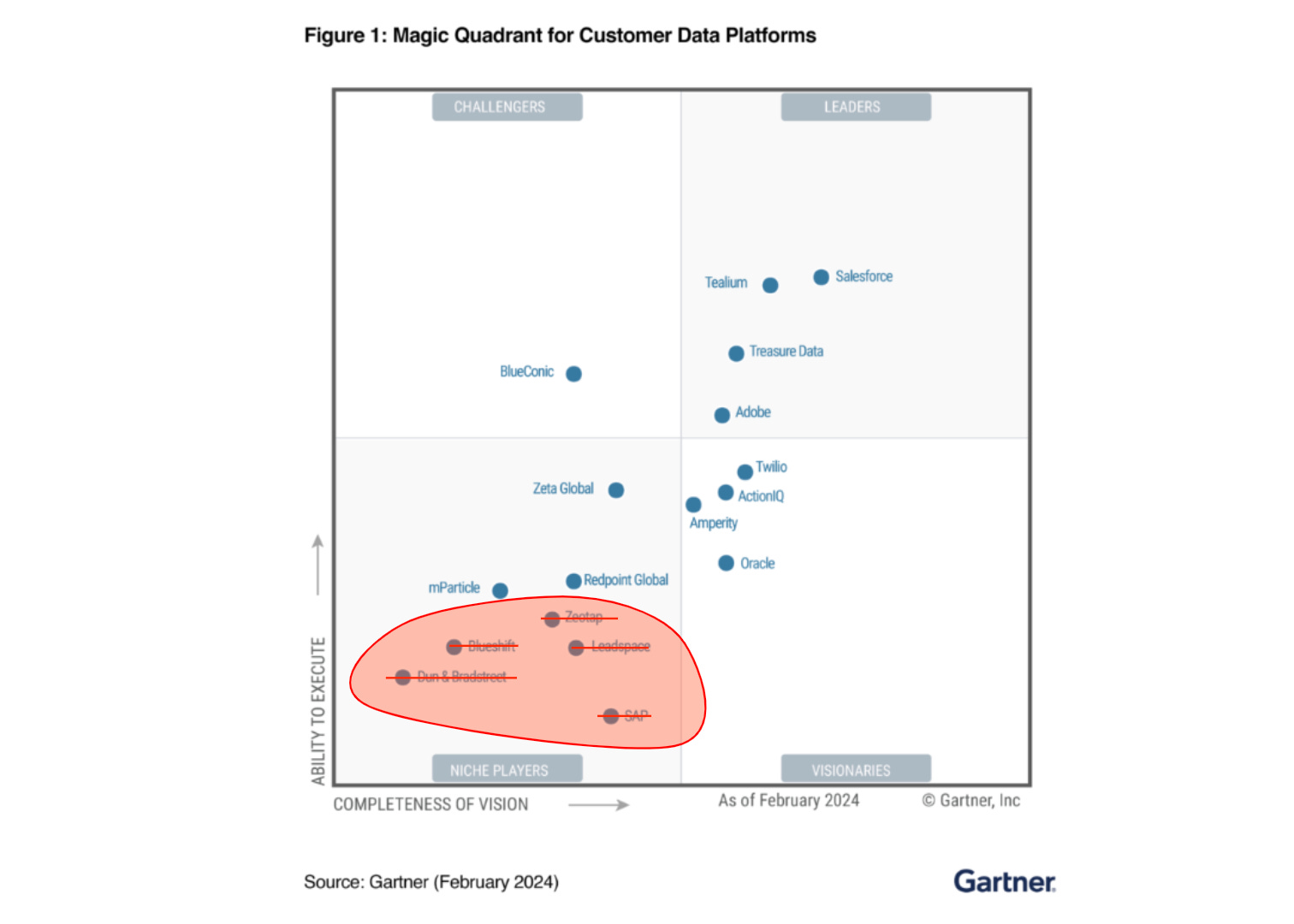
Trough of Disillusionment?
For the 12 vendors remaining, it's insightful to overlay this year's report with the 2024 edition to observe the market's evolution:
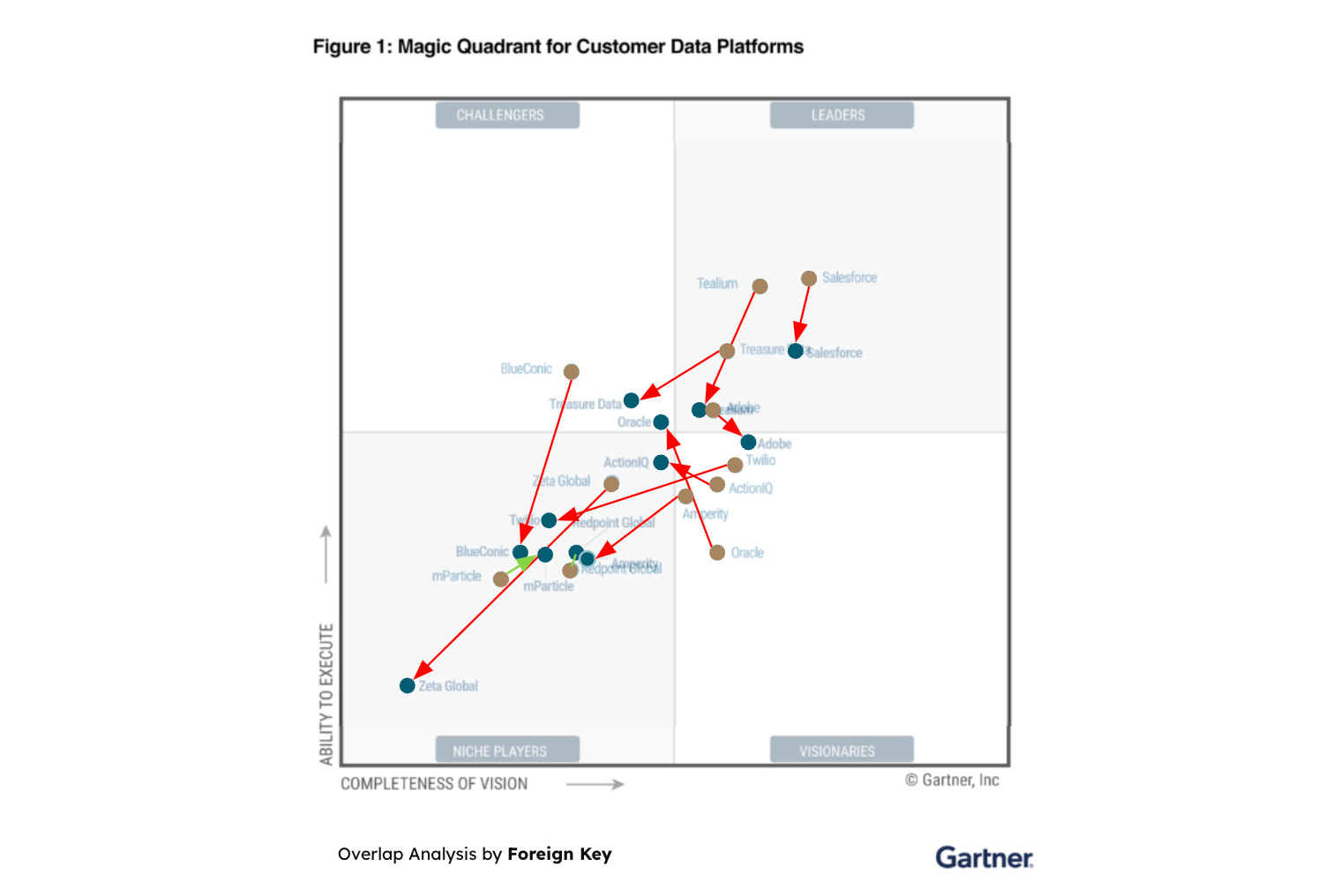
Without AI-driven analysis, just a simple visual observation:
10 out of 12 vendors have regressed in their positions.
Only two vendors have shown progress, and even then, they remain niche players with minimal advancement.
One vendor notably improved in its Ability to Execute, according to Gartner, but simultaneously declined in Completeness of Vision.
Reflecting on Gartner's famous Hype Cycle, this current state strongly resembles the "Trough of Disillusionment." I'm honestly unsure if previously there's ever been such a widespread category regression within just 12 months.
Interpreting Gartner's evaluation suggests:
Ability to Execute: CDP project success rates in the past 12 months are underwhelming.
Completeness of Vision: There's less confidence in a brighter future for CDPs.
What’s Next for CDPs?
Gartner’s latest report confirms the perspective I shared earlier this year: we're in a transitional phase for CDPs. Between the evaluation and publication of the report, 3 major independent CDP vendors exited through an acquisition (ActionIQ by Uniphore, Lytics by ContentStack and mParticle by Rokt).
Other vendors are actively looking to reinvent themselves rather than relying on the CDP category as the gold mine it once seemed to be.
Interestingly, it feels like Data Management Platforms (DMPs)—the very technology that CDPs were supposed to replace through their focus on first-party data—had a longer market run than CDPs themselves.
The shift toward Customer Engagement Platforms (CEPs) continues to be a straightforward evolution, entering in a field occupied by major CDP partners.
But CEP isn't the only direction vendors are exploring. There’s rising interest around decisioning, an area that I've always felt has had limited market offerings. Recent moves such as Hightouch launching AI Decisioning and Braze acquiring OfferFit clearly signal growing momentum here.
Many vendors are actively redefining their identities, taking different strategic paths and branding approaches:
Amperity: Customer Data Cloud
BlueConic: Customer Data OS
Census: Universal Data Platform
GrowthLoop: Compound Marketing Engine
Imagino: Customer Engagement Platform
Tealium: Intelligent Data Platform (leading name on their website, despite being a leader in Gartner’s CDP Magic Quadrant)
Without judging these new labels, it's clear that buyers and technology stack owners face an extremely complex period to navigate.
Speaking of buyers and stack owners: what does this mean if you have one or more CDPs already in your stack, or if you're evaluating them?
I wouldn't be alarmed by the apparent implosion of the CDP category. It was never consistently defined, and vendors classified as CDPs had widely varying strengths and weaknesses. This undoubtedly explains why enterprises sometimes ended up with four or five "CDPs" simultaneously—each serving (hopefully?) a distinct purpose.
🔑 Enterprises should never select vendors based purely on category labels. Instead, the focus must always be on solving specific business challenges—whether that's first-party data collection, creating a unified customer view, audience segmentation, orchestration, decisioning, or something else. Categorization is meant to simplify the process by grouping vendors with similar capabilities, yet this never fully succeeded for CDPs.
I won't predict exactly what's next for these vendors, but it's been fascinating to watch the speed at which they've pivoted their strategies away from being “CDP-First.”