
The Zero-Click Mailbox

In Martech, we’ve used the language multichannel and omnichannel extensively. The reality? Ask any marketer — email remains the number one “owned” channel. It’s cheap compared to alternatives, and research consistently agrees: email remains one of the most efficient ways to communicate with customers.
In 2026, Google doesn’t just dominate search. Alongside Apple Mail, it dominates the email client market with Gmail. And as you’ll see in this post, there are more parallels to be drawn between search and email.
I want to pause for a minute on January’s Gmail announcements.
AI is changing everything. You thought it was only going to change email content creation? Think again — a much more disruptive change is coming.
Google bundled a number of “AI in Gmail” capabilities under one umbrella:
AI Overviews: Summarize email threads and answer natural-language questions about your inbox without opening individual messages.
AI Inbox: A new Gmail mode that ranks and surfaces emails based on inferred importance, relationships, and predicted relevance — prioritizing what the user should see first.
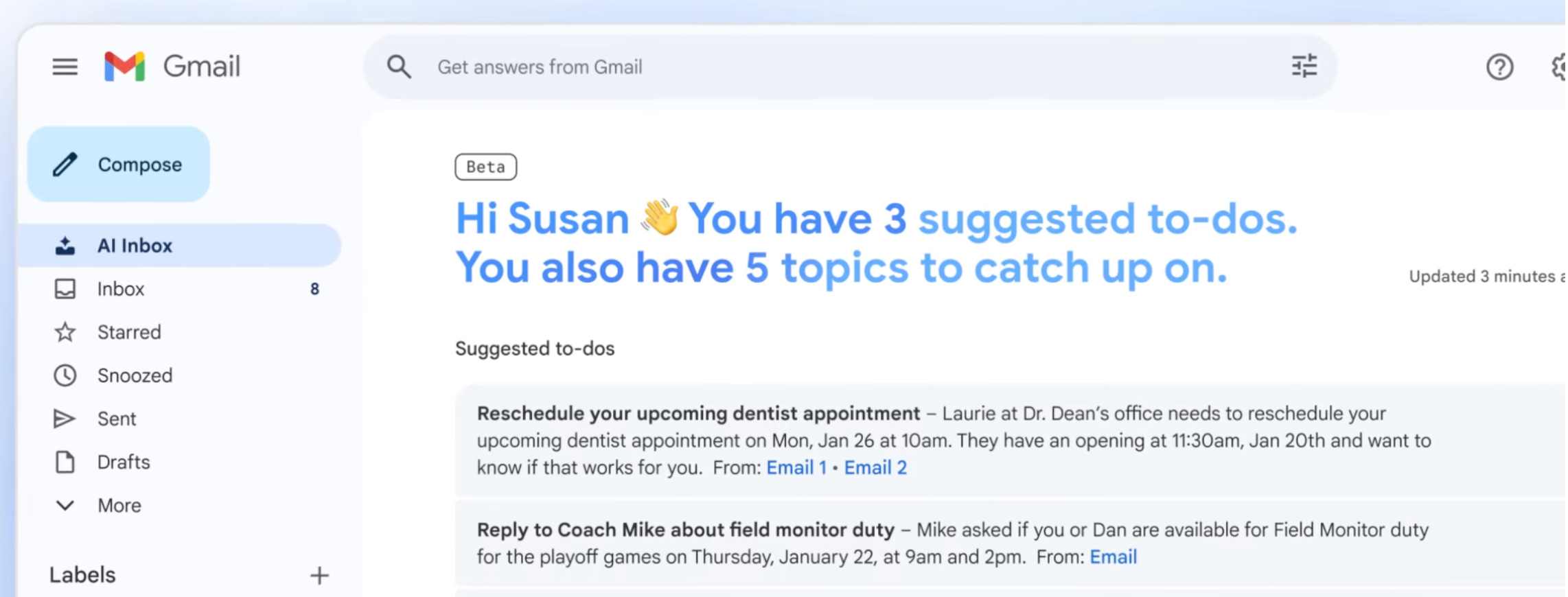
Gmail is shifting from delivery and sorting to interpretation and decisioning and that changes the rules.
I’m refraining from using “from X to Y” (thank you GenAI), but sometimes it’s just the right way to frame information. And I may use it more than once in this post.
Historical Evolution Precedents
Email has been evolving for decades.
Gmail isn’t at its first trick to play with marketers’ feelings – sorry, to help the consumer. One of the reasons for its early success was its ability to filter emails it flagged as spam and automatically remove them from users’ sight.
More recently – sigh, I’m aging myself, 2013 is already more than 10 years ago – Gmail added the Promotion tab, deepening the visibility fight, getting into the main inbox of consumers.
With Mail Privacy Protection (MPP), introduced in 2021, Apple introduced a privacy feature that prevents email senders from tracking user activity. It impacts measurement for marketers.
So if, historically, Gmail decided where something lands (spam vs inbox, Primary vs Promotions) with somewhat disruptive changes, it’s nothing compared to what Gmail just announced. Gmail is increasingly deciding:
what it is (semantic classification and summarization)
whether you should care (AI relevance and VIP inference)
what you should do (to-dos, reminders, suggested actions)
Google says this directly in product terms: AI Inbox “filters clutter,” highlights “to-dos,” and surfaces VIPs using relationship signals and past behavior.
Entering The Era Of The Zero-Click Mailbox
The zero-click approach is coming to your mailbox as well.
With AI Overviews in Gmail, users can get answers to their questions without… clicking on an email.
The same way we now talk about zero-click search, we are going to see the rise of the zero-click mailbox. In place of blue links not being clicked, subject lines normally clicked to open an email may remain unread.
This “ask your inbox” experience is showing a new direction of travel: email becomes something you query rather than something you browse.
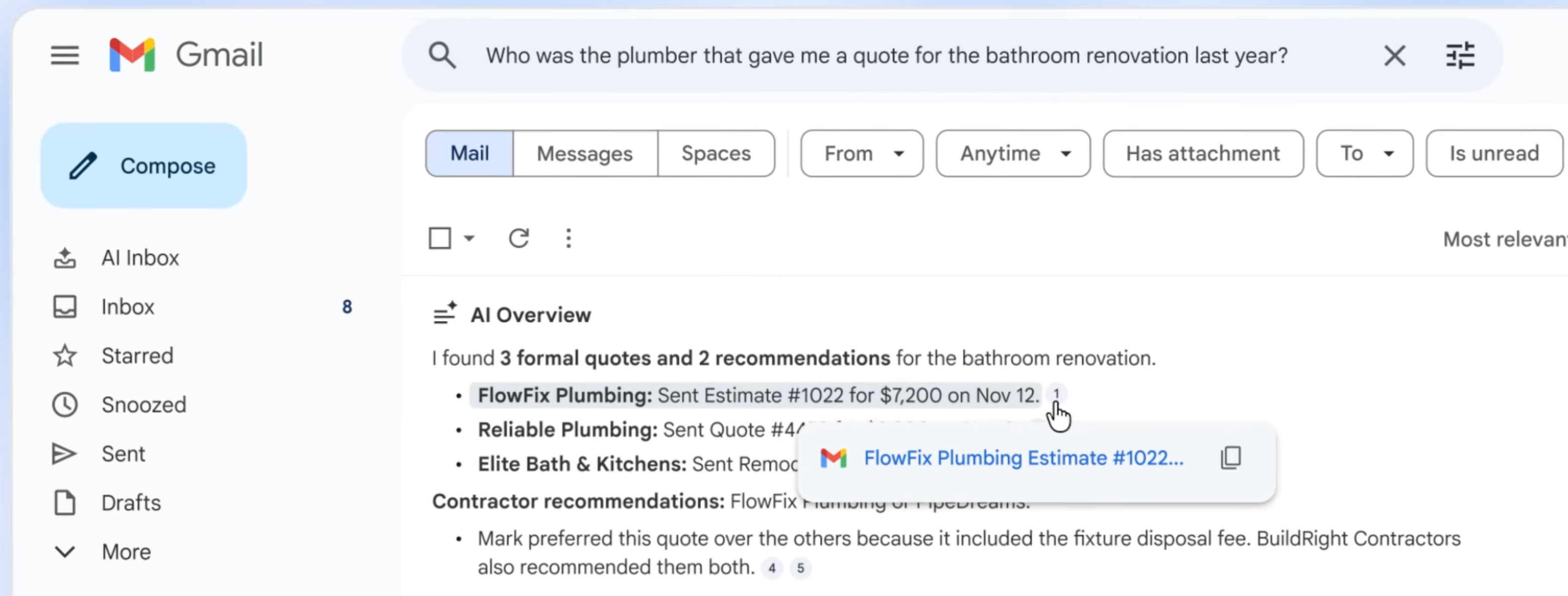
If AI Overview is making emails a dataset and Gmail a query engine, the rules change.
Parallel with Search
Web growth led to search, mailbox growth is heading towards the same destiny.
You are certainly familiar with AI Overview in Google Search at this point, extensively rolled out and creating headaches for many marketers and publishers. With AI Overviews in Search, users can get answers to their questions without clicking a blue link and opening a website.
Despite the complexity of email deliverability — if experts have full-time positions dedicated to it, we can’t say it’s easy — best practices are widely understood. Even without full transparency into filtering algorithms, the industry has a good understanding of what to do.
In a way, it’s a bit like SEO. Experts don’t know the algorithm, but they know the best practices and tricks to optimize results.
The same dynamic is emerging in the inbox.
The case for the Inbox GEO
The “zero email in the inbox” objective is one fewer and fewer people attempt to live by — and it likely inspired Gmail’s team to make these changes.
Personally, I’ve done my best to keep up with my emails, mostly through extreme rigor in what I sign up for.
But some users are already consuming their inbox differently.
Listening to Dela Quist on the Making Sense of Martech podcast, I was surprised to hear that he refuses to delete emails or unsubscribe. He’d rather be able to search through his inbox.
I would argue that Dela is more the exception than the norm today. Gmail is taking action so that this behavior will become standard.
My bet is that we will see the rise of a new skill: the Inbox GEO (or Inbox AIO — either works).
For a long time, we focused on the subject line to get users to open emails, and then on the content to get them to click.
In a zero-click mailbox, that sequence no longer holds.
Consequences for KPIs
The value of email opens as a KPI has already been questionable in recent years (e.g., Apple MPP). It becomes useless when users adjust their behavior and adopt AI Overviews or the AI Inbox as their primary way to consume their mailbox.
Interpreting Gmail’s algorithm, today, the measurement of an email’s importance is still largely driven by engagement signals such as opens and clicks. If you frequently engage with a sender, Gmail can easily infer that interest.
But if we are entering a zero-click era in the inbox, Gmail itself begins to lose those signals.
Fewer opens. Fewer clicks. Less direct engagement to measure.
Maybe AI Inbox introduces new clickable elements that can serve as signals. Even then, those clicks would be highly influenced by Gmail’s own decision about what to surface in the first place.
The interpreter starts shaping the signals it later uses to decide.
Predictions: what is going to happen
Consumer Prediction: Consumer behavior will change
Change is hard. People don’t change easily, so the common thinking is that change will take time.
That said, looking at the evolution since the rollout of ChatGPT, change has been massive and quickly adopted. We are at the beginning of a new era. Agentic commerce is starting. Consumers are already using natural language interfaces to get direct answers to questions, to shop for products they need, and more.
So maybe it’s the easiest prediction of all: AI Inbox and AI Overview will be adopted, and users will adjust how they consume and treat emails.
Marketer Prediction: From getting users’ attention to getting AI’s attention.
The subject line was how marketers got users’ attention.
We are already discovering in many areas that companies will have to learn how to interact with AI agents, not just humans. The same is coming to email.
The new battleground will be understanding how to get Gmail’s AI system’s attention so that email’s information is surfaced.
Gmail Prediction: Google’s Inbox AI algorithm is at its infancy
Let me explain what I mean when I suggest that Inbox AI’s algorithm is likely at its infancy.
We discussed that today, the measurement of an email’s importance is still largely driven by engagement signals such as opens and clicks. If you frequently engage with a sender, Gmail can easily infer that interest.
But in a zero-click era, Gmail itself starts losing those signals.
Maybe AI Inbox introduces new clickable elements that can be used as signals. Even then, those clicks would be highly influenced by Gmail’s own decision about what to surface.
With its usage cannibalizing the signals it relies on, Inbox AI will need to evolve alongside its adoption.
Market Prediction: Email frameworks will be released
APIs were not built for agents, which is why Anthropic introduced the Model Context Protocol (MCP). More frameworks have been released since then.
I’d bet it won’t take long, once Gmail’s new AI features are widely adopted, for an email framework to emerge.
Follow the framework, increase your chances of being picked up and correctly understood by AI Overview and AI Inbox.
Can’t wait to see someone introduce the Email Context Protocol (ECP)!
Rethinking Email
I alluded to a few points already: zero click, losing engagement signals, losing control and guaranteeing that a good subject line leads to a click. Email will change. Drastically.
For the past couple of years, we really thought that GenAI was going to make email content creation easier for marketers. Describe your goal and get a complete email in your brand style and tone ready to send. Not just text, but layout and images as well. Actually, Hightouch recently released a product/feature called Content Assembly in that direction.
However, all of these are built for today’s email rules.
With AI Inbox and AI Overview, marketers will have to rethink email, from the ground up. We could see a resurgence of plain text emails. After all, these new AI features are built for text today.
Marketers and copywriters will have to carefully select words and email structure. It’s not about grabbing users’ attention but grabbing AI’s attention first, and hoping that the language then surfaced to the user isn’t distorted.
Plain text emails will be structured. Generative AI is great at analyzing unstructured emails. But risks will be reduced by increasing the structure.
For example, I can expect the (Email Context Protocol) framework to include a clear CTA (call to action), a clear date/date limit, etc. A few typical email information elements creating a standard.
Beyond the content strategy, other aspects of emails could change such as the frequency of emails being sent. If AI Overview is making emails a dataset and Gmail a query engine, does it mean that marketers could flood the inbox moving forward? And “hope” something will appear to the Overview due to the frequency of the brand appearing in the Inbox?
That would only be true if in parallel spam filters are adjusted.
This isn’t the first time marketers lose control but it might be the first time they lose the reader.
🔑 For the first time, your emails are written for one audience — but interpreted by another.