
Agentic AI’s First Step isn’t Autonomy, it’s Integration

From “Agentic Year” to Hybrid Reality
Back in January, I talked about 2025 as the agentic year, believing it would be a time for conversation and experimentation rather than full deployment. Enterprises aren’t ready to hand the wheel to AI just yet.
Instead, we’re seeing something more practical emerge: AI embedded into traditional systems and workflows. Not standalone agents running in the wild, but AI that accelerates what humans already do inside trusted tools and processes.
This isn’t the agentic revolution yet. It’s the hybrid frontier, where generative and agentic AI coexist inside the workflows we already know.
Efficiency Meets Control
Every organization wants the same two things from AI: efficiency and control.
Generative AI promises efficiency. But control — the ability to validate, govern, and stay compliant — still depends on traditional systems, processes, and human oversight.
That tension is shaping how most teams adopt AI today. Instead of giving AI end-to-end ownership, they use it as a phase-one accelerator: the starting point for faster creation and iteration.
Take Google Forms. You can now describe a form in natural language, and Google generates the skeleton automatically (a partial rollout for now). The result isn’t final, it lands right back in the familiar form builder, where you review, tweak, and publish.
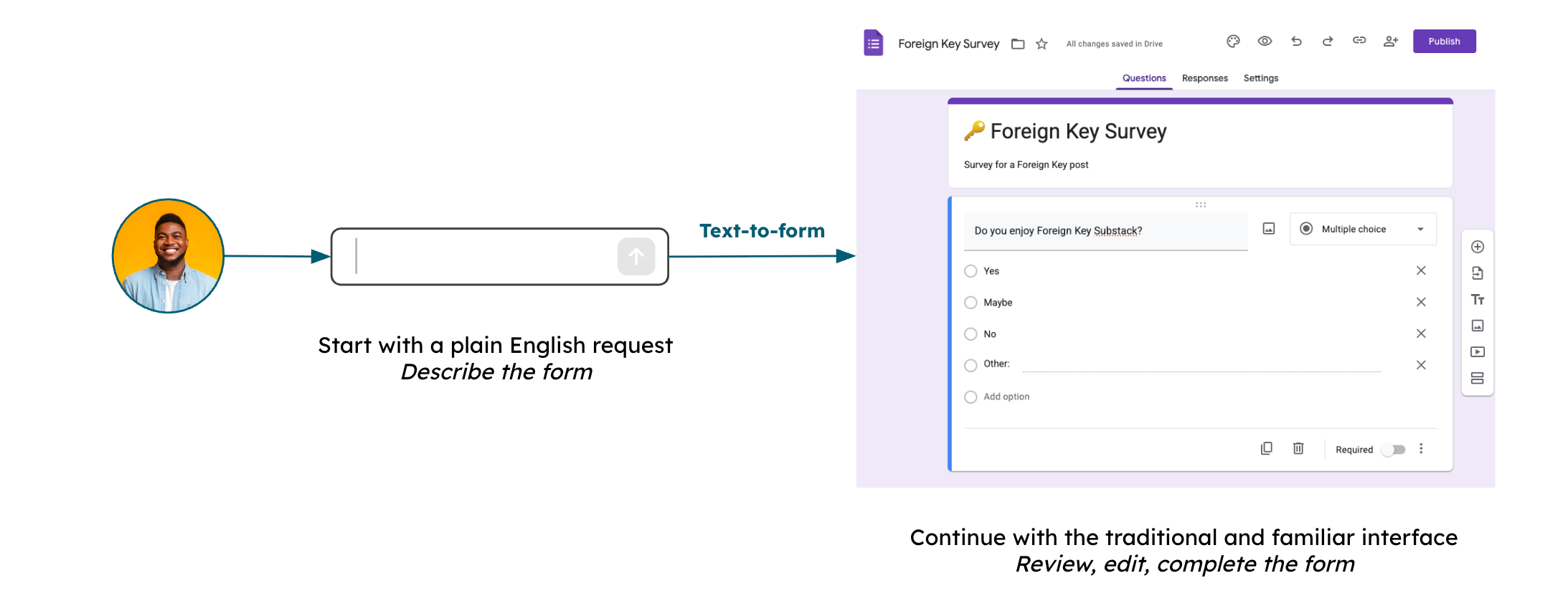
Or consider solutions like Twilio Segment and GrowthLoop. Describe an audience in plain English, and the system translates it into a defined segment inside your Martech UI. You get the quickstart speed of natural language with the reassurance of your standard controls.

That’s hybrid AI in action: speed first, control always.
Embedded Intelligence, Familiar Interfaces
The most successful GenAI use cases this year don’t look like new apps — they look like upgrades. AI is being “quietly” embedded inside the software people already trust.
Snowflake Copilot inline is a great example. Users can start writing a SQL query, ask Copilot to refine it, then keep editing manually, never leaving the classic interface. The AI disappears into the background as soon as it accomplishes its task.

This embedded model is gaining traction fast because it fits how people actually work. AI handles the tedious setup; humans stay in charge of decisions and quality.
Unlocking New Value, Minimizing Risk
The hybrid approach to AI implementation isn’t just about efficiency — it’s also unlocking value from data that was previously out of reach.
Most enterprise systems were built around structured data, yet today’s world overflows with unstructured assets: PDFs, support calls, chat logs, video transcripts. AI can extract entities like products, order numbers, or sentiment from these assets and translate them back into structured records — ready for your analytics and governance workflows.
This “unstructured in → structured out” pattern lets teams explore new AI-powered capabilities without rearchitecting their entire stack. It’s innovation within familiar boundaries, and that’s exactly why it’s gaining traction.
Why Hybrid Wins (for Now)
For most organizations, hybrid workflows are the most workable form of AI transformation. They:
Accelerate without disruption. AI enhances existing tools and processes instead of replacing them.
Build trust incrementally. Teams can learn, observe, verify, and adapt as they go.
Preserve oversight. Compliance, governance, and human checkpoints remain intact.
You don’t need to “go all in” on agents to see real impact. The hybrid model lets you learn safely, and still deliver measurable gains.
The Ceiling of Hybrid Models
Let’s be clear: hybrid isn’t the destination.
When AI outputs always flow back into legacy systems, those systems define the ceiling of innovation. Text-to-SQL was a breakthrough in 2024, but what if the future of querying data doesn’t involve SQL at all?
Or back to Google Forms. Generating one from a prompt is clever, but maybe the form itself is the constraint. True reimagination will mean breaking out of these legacy metaphors entirely.
The hybrid frontier gives us safety, but it can also hold back reinvention.
What Comes Next
New startups are already asking the next question: what if we didn’t have to go back?
They’re building natively agentic systems, where human intent flows continuously through AI, defining new standards instead of being locked into the past.
Established SaaS players, meanwhile, are threading AI deeper into their existing products. They benefit from user trust and adoption, but at some point, they’ll need to decide whether to keep optimizing the old, or start inventing the new.
🔑 The path to agentic AI doesn’t have to be a leap, it can be a bridge. Hybrid workflows are how enterprises build trust and value today.