
Databricks Built a CDP: Time to Rebundle and Repeat History

Disclosure: I’m a former ActionIQ employee and a current Snowflake employee. The opinions below are my own. They’re based on public information and shouldn’t be read as anything about Snowflake’s strategy, current or future.
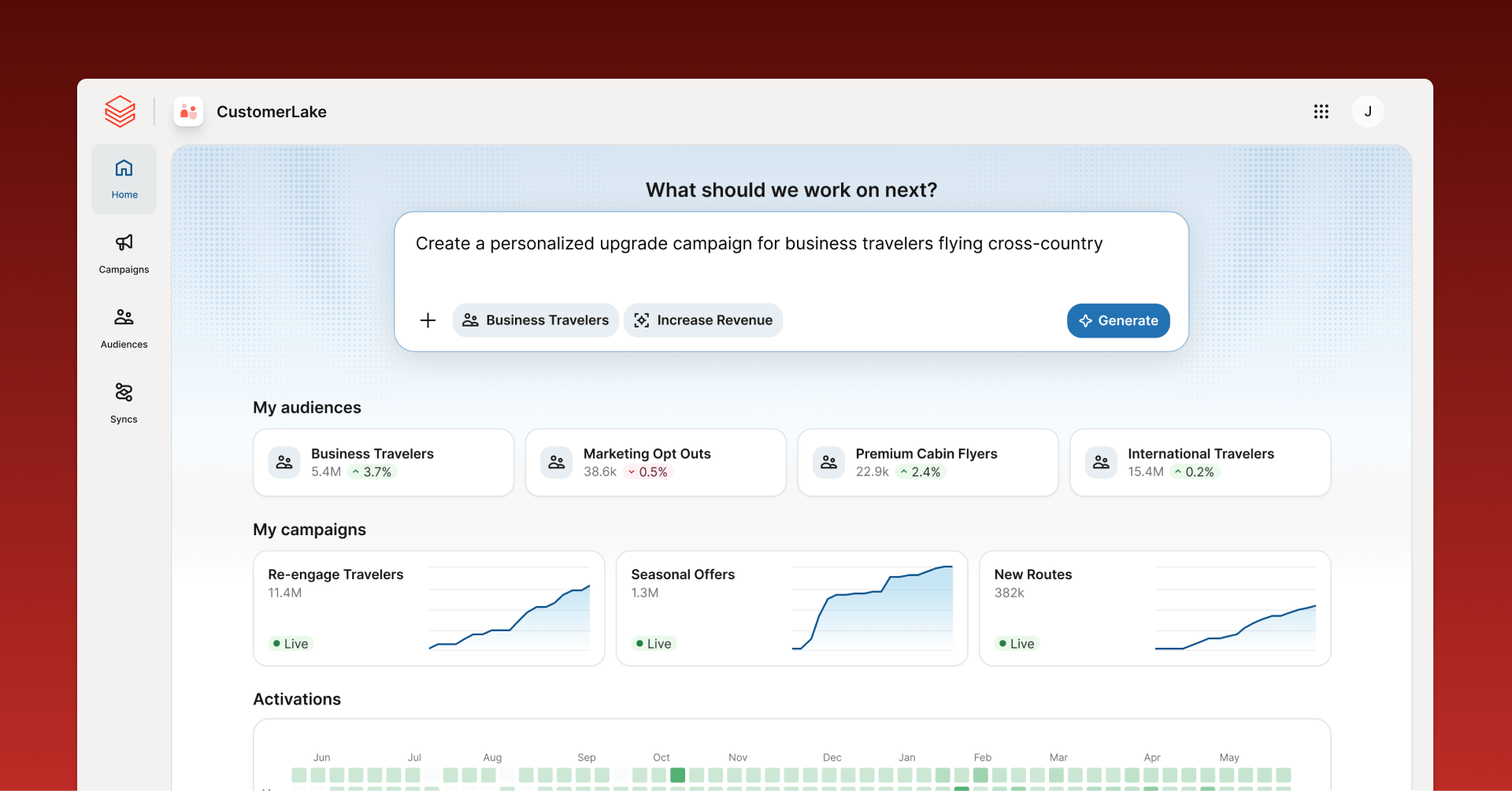
Yesterday, at the Data + AI Summit, Databricks ended weeks of speculation and announced CustomerLake, an “Agentic CDP” built natively on the lakehouse. If you follow this space, the news landed somewhere between “finally” and “called it.” The worst-kept secret in martech is now a product in Private Preview.
The easy questions have boring answers. Who gets disrupted? All the CDPs. Which partner is most nervous this week? Take your pick.
What’s worth chatting about is direction. For years, martech vendors marched towards the data. CDP vendors moved the other way. They left the data to the Cloud Data Warehouse and focused on the business functionality, such as campaign and journey orchestration. Cloud Data Warehouses stayed “passive” players in the space, quietly collecting the value of everyone else’s effort.
Databricks CustomerLake is the cloud data warehouse deciding it’s done being passive.
We’ve seen this bundle before
Software bundles, then unbundles, then bundles again. Customer data itself has run this loop before.
The first time marketing workloads landed on serious data infrastructure, the players were Teradata, IBM, and Oracle, back in the RDBMS era.
Teradata built in-house, then bought Aprimo, and shipped Customer Interaction Manager (CIM), a solution still on the market today, even if the people running it aren’t thinking about LLMs at night.
IBM bought Unica (since divested), while Oracle assembled a suite around Responsys and Eloqua. The data lived in the warehouse, and the marketing application from the same vendor could sit right on top of it, bundled.
It made sense. Customer data is large and expensive to move, so doing the work where the data already sits was the path of least resistance.
Then packaged CDPs arrived to give marketers a unified, cloud-based customer database of their own, separate from IT’s warehouse. At the time, BigQuery, Databricks, and Snowflake were nascent at best.
I helped launch ActionIQ’s composable CDP offering, and the pitch for composability was explicitly about optionality: keep the data in the warehouse, run the business logic in a layer above it. Deploy a composable architecture, pick and choose the components you need. Yes, I know, the nuance between Composable CDP and composable architecture has been difficult to grasp. Some people said it would never work. Others pointed out the obvious: software is a permanent cycle of bundling and unbundling, and that one day the capabilities might just bundle back. Well, here’s the bundle, back!
Databricks CustomerLake brings Customer 360, identity resolution, audience building and activation into the lakehouse, where the data already lives. Strip the “agentic” framing for a second and the architecture is the Teradata move, rebuilt for 2026: the application, sitting natively on the data platform.
Databricks CustomerLake, a CDP?
I don’t have insider information, but I’d bet there was a lively debate inside the building: do we announce this as a CDP, or not?
The decision looks like a bit of both. Databricks named the solution CustomerLake and positioned it as an Agentic CDP.
The CDP label is there to help buyers place the product in their stack. Tasso Argyros, who founded ActionIQ and now leads the engineering team behind the Databricks product, spent more than a decade getting the CDP category recognized by the market and by analysts.
He has no obvious interest in starting that fight over from scratch with a brand-new category. So the team is threading a needle: leaning on an existing budget line and a familiar slot in the stack, while disrupting the expectations that come with it.
Fun fact noting where Tasso started: he co-founded Aster Data, which sold to Teradata, then founded ActionIQ. He helped unbundle the warehouse-marketing model, and now he’s bundling it back. We opened on Teradata, and going full circle!
The map, with a new arrow on it
I’ve been drawing the martech stack as a battlefield for a while now, and people seem to appreciate the visualization: the jobs to be done by marketers, and the tech categories occupying them as each one looks to expand its revenue opportunity.
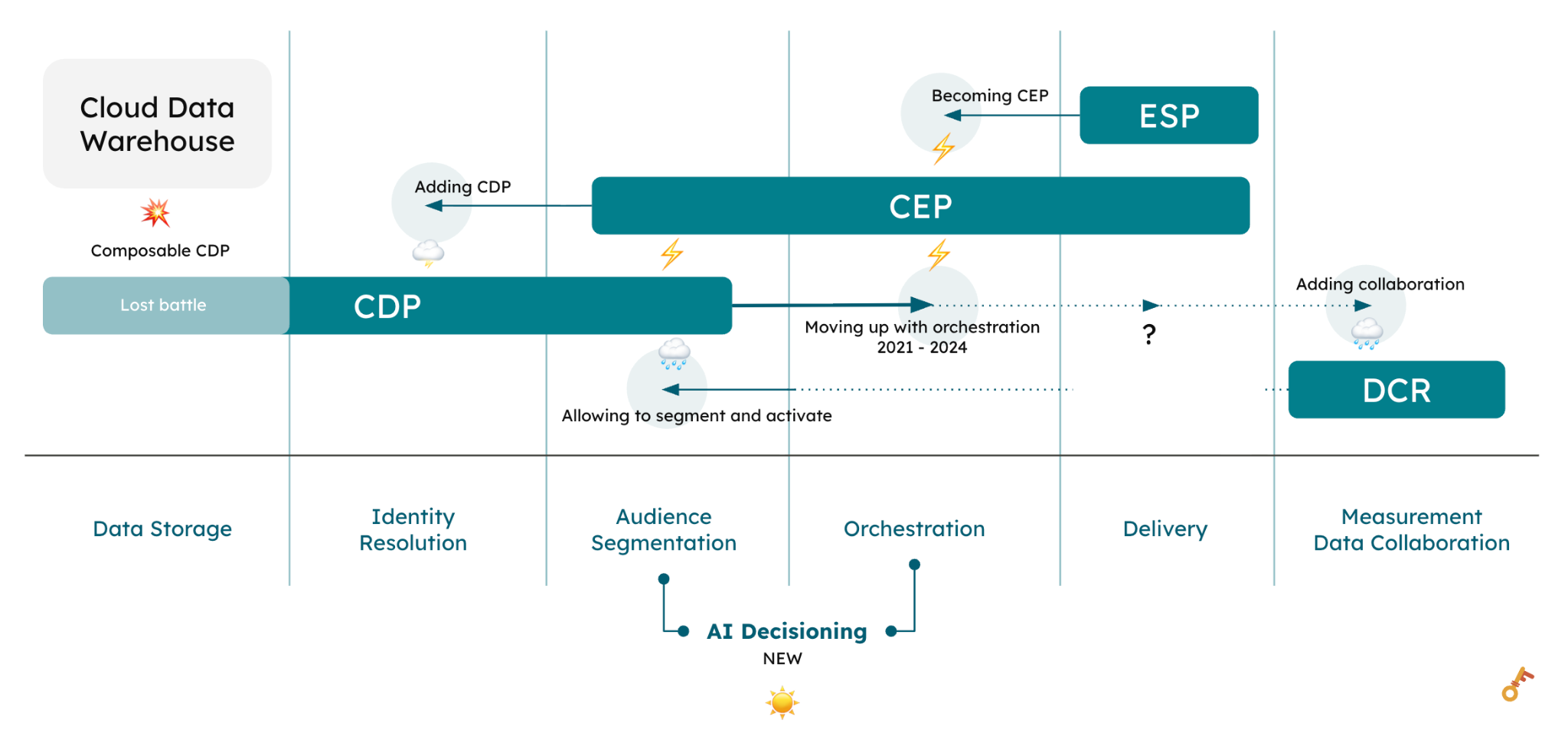
CDPs lost the data storage battle to the Cloud Data Warehouse, so they pushed right into orchestration between 2021 and 2024. CEPs marched left, adding CDP capabilities. That didn’t work too well, as expected: adding business functionality is much harder than building back data infrastructure.
Everyone crowded toward the middle, fighting over the business functionality. Notice who never moved? The Cloud Data Warehouse. It didn’t need to: marketing workloads kept arriving on their own, because that’s where the data is.
The Cloud Data Warehouse won the data storage battle by default, and let everyone else do the work of activating it.
Databricks CustomerLake just drew a new arrow.
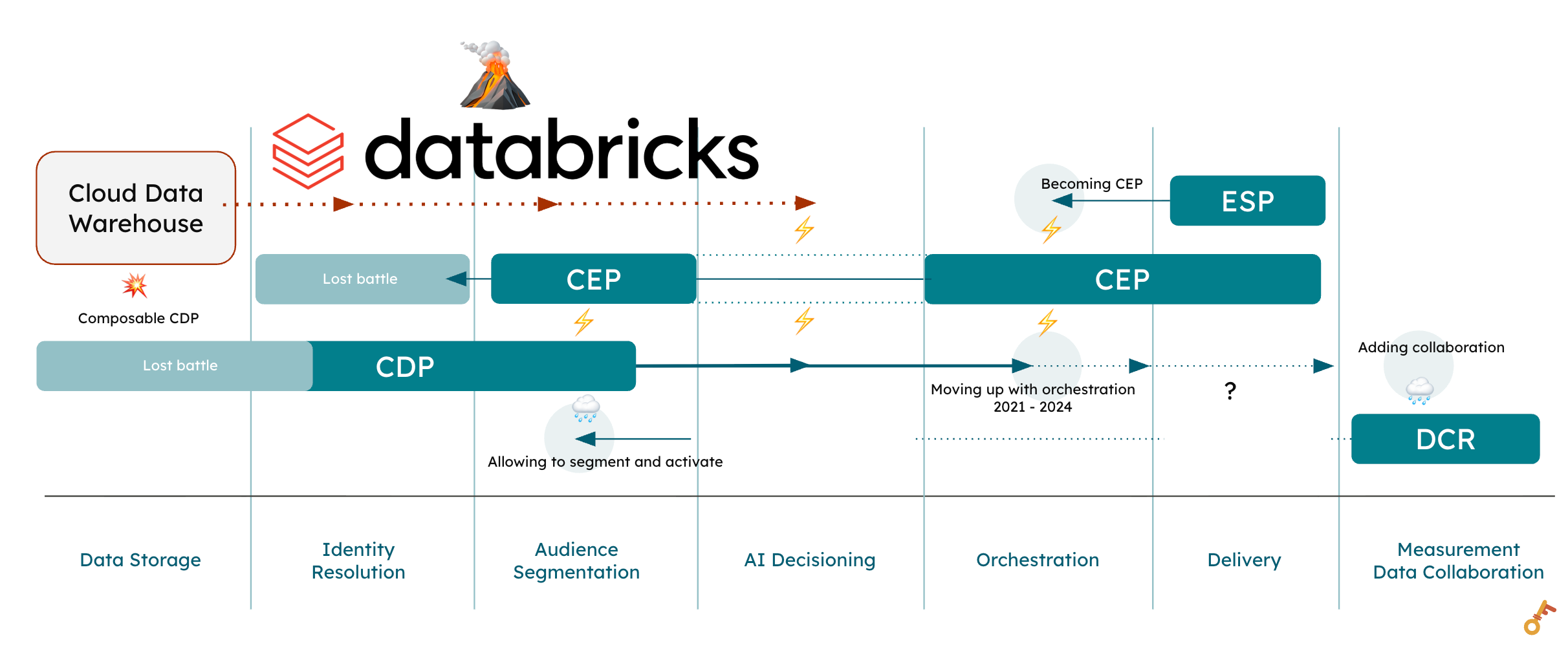
The data platform steps off data storage and into identity resolution, audience segmentation, and the territory the CDP spent a decade claiming.
The quiet part: decisioning
Most of the coverage led with a workforce of agents and a billion 1:1 personalized experiences a day. But what they announced in the background is a decision engine: who gets targeted, with what, and where.
I argued last year that decisioning is the real next battleground in martech. Marketers struggle because every customer journey spawns more decisions than a human can define, test, and maintain by hand. The old answer was rules. I’ve built those libraries for customers, and they get unmanageable fast. So organizations simplify, strip out rules, and quietly accept worse marketing.
The pitch for AI decisioning is that you stop writing the rules and let a model work toward the goal instead. Define “grow loyalty enrollment,” and the agent figures out the audience, the offer, and the path. Deterministic logic gives way to probabilistic, leveraging the new power of LLMs.
Databricks isn’t first here – Hightouch shipped AI Decisioning, Braze bought OfferFit, Adobe had Offer Decisioning for years. What sits close to the data, though, is context. Both matter for a good decision: a model with thin or stale context just makes the wrong call faster, and with more confidence.
Sooner than later, decisioning will move from the background to an explicit point of conversation.
That said, watching another demo tempered my read. The user still chose the channels and set the campaign duration by hand. So the Campaign Agent looks less “infinity campaign, no manual rules” than the launch suggested, and more like assisted decisioning, at least in the current design.
The genuinely new part: a hybrid interface
Here’s where I’ll give Databricks real credit. There are two ways to build martech right now:
The incumbents give you the familiar drag-and-drop: canvases and segment builders, the visual grammar marketers have used for fifteen years.
The AI-native startups threw that out and rebuilt everything around a single chat box. Talk to the system, and it does the work.
CustomerLake takes a third path. The interface keeps the components a marketer already recognizes, but threads AI through all of them. Chat is present, but inside the context of a familiar tool rather than replacing it.
That’s a smart bet. Most marketing teams are nowhere near ready to hand a journey to a fully autonomous agent and walk away. A blank chat box asking them to trust it is a hard sell. But a plain CDP with an AI label slapped on the side excites nobody in 2026 either.
The hybrid threads that needle: new enough to matter, familiar enough to consider adopting.
Whether they drew the line in the right place is the open question. Which decisions get automated, which stay human, which the system makes and lets you override.
I’ve only seen the short public demo so far, not enough to judge whether they found the right balance.
The catch: you won’t run it alone
Here’s the thing a launch demo never shows you. CustomerLake arrives in a stack that already has a CDP (composable or not), alongside another complex set of martech tools integrated 50% of the time. Nobody is sure which 50%.
The direction can be right and the thing can still be hard to land. Martech is genuinely complex to get right, and Databricks shared enough to get people excited, not enough to prove it works for real customers in today’s stack. Which could be fine, considering it’s a Private Preview product.
Initially, almost nobody will rip out what they have to adopt CustomerLake. They will run it alongside their existing tools, covering the same jobs: audience segmentation here and there, campaign orchestration in two places.
Which raises the operating question: which tool do you use, and how do they talk to each other? Beyond the duplicate segmentation logic, there’s the Customer 360 from Profile Agents. Is it trustworthy enough to replace your current C360, or do you start carrying multiple definitions of your customer?
Assuming I’m right and customers run CustomerLake alongside traditional solutions, the change management and operating guidelines will matter more than the technology.
History repeats. Then what?
Here’s the part that should keep a buyer honest. Every company in that opening paragraph eventually walked away from the bundle.
IBM exited marketing software in two moves: Unica to HCL in 2018, then the rest of Watson Marketing to a private equity firm in 2019, where it became Acoustic. Teradata still lists CIM, but the investment dried up a long time ago. Oracle’s marketing suite is a shadow of the acquisition spree that built it. The bundle made sense, right up until the platform owner decided marketing wasn’t the core business and quietly stopped feeding it.
But that’s the long game. The thing to watch right now is that a cloud data platform just decided marketing software is worth owning outright.
🔑 Forget the CDP label. The real fight is over who owns the marketing jobs that sit on the customer data, and that battlefield just caught fire.
Loved the graphs, great analysis!